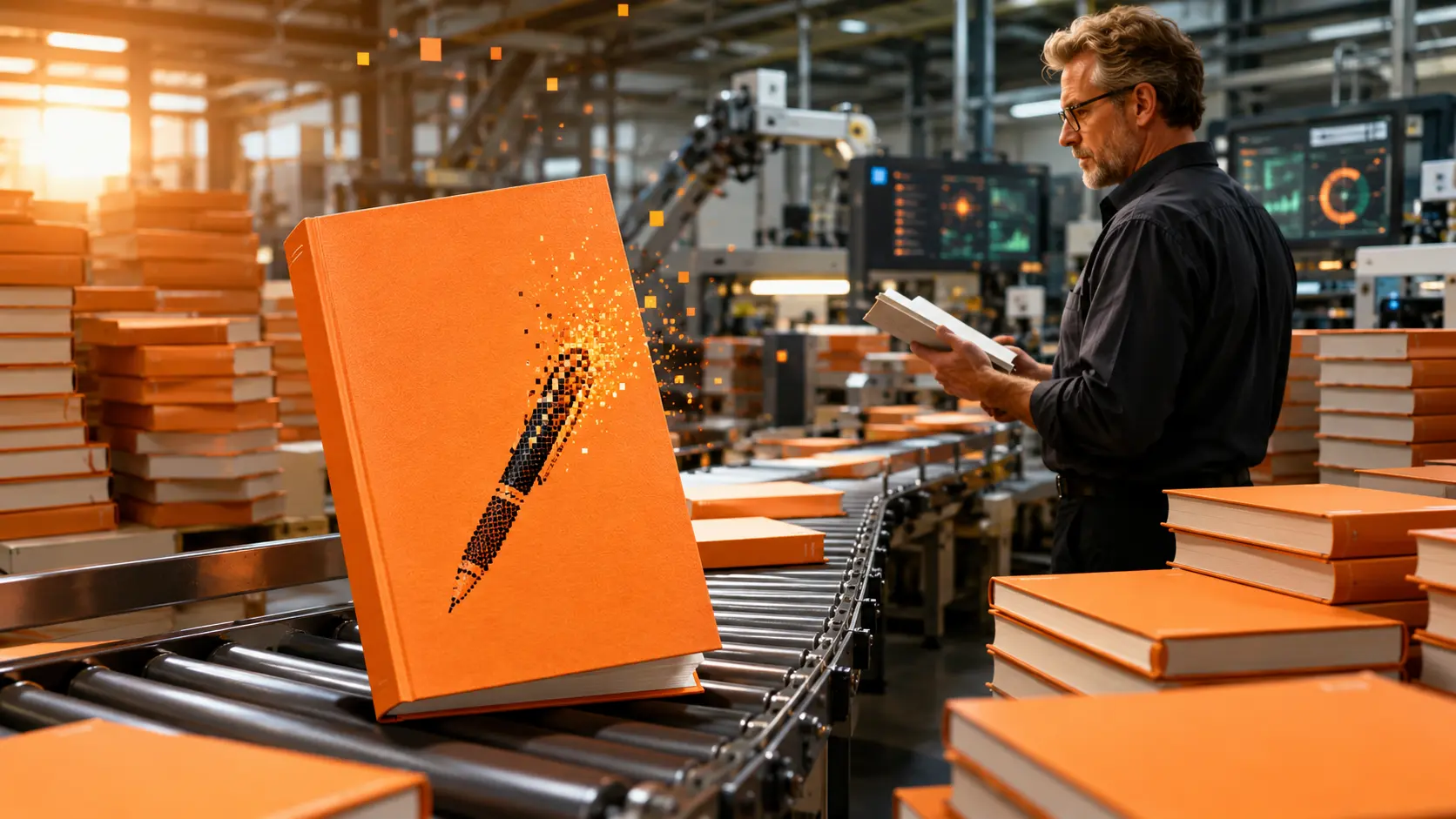
A South Holland company has published thousands of Dutch-language books in a short time using artificial intelligence. According to an investigation by Trouw, Andries B.V. now sells more than two thousand titles via major online book platforms, while many retailers barely disclose that the content is AI-generated.
The case exposes a growing problem in the fast-moving AI publishing market: consumers often can’t tell whether a book was written by a human author or largely produced automatically.
AI publisher races to build a massive catalog
Trouw reports that Andries B.V. releases roughly ten new books per day on average. The company focuses on niche non-fiction with titles like “Everything About…” followed by a wide range of topics, from philosophy and hobbies to specific cities, animal breeds, and technical subjects.
Production is almost entirely powered by artificial intelligence. Founder Andries Herremans confirms to Trouw that multiple AI models collaborate during the writing process. These models generate topics, draft text, edit, and design covers.
The books are sold via print-on-demand—copies are only printed after an order is placed. That lets the company offer thousands of titles without large inventories and at relatively low cost.
Retailers often skip AI labeling
The debate escalated because many Dutch retailers did not clearly communicate the AI origin of these books. According to Trouw, Bol.com was for a long time the only major seller that explicitly labeled certain titles as “AI-generated.”
Other platforms, including Bruna, Libris, and various online bookstores, initially did not show that information. After questions from Trouw, several parties decided to add warnings or labels to the relevant titles.
It points to a broader shift in publishing: platforms are increasingly forced to decide how AI content should be made visible to consumers.
Authors’ Guild calls it “alarming”
The Dutch Auteursbond is sharply critical of large-scale AI publishers. Noor van der Heijden of the Auteursbond calls the scale on which Andries B.V. operates “unprecedented” and “alarming.”
The organization argues that many generative AI systems are trained on copyrighted material without explicit permission from writers. As a result, AI systems end up competing with authors using text that is originally protected by copyright.
That debate is global. In the United States, lawsuits have been filed against OpenAI, Meta, and Anthropic over the use of books and journalistic content for AI training. European publishers and authors’ groups are meanwhile calling for stricter transparency rules around AI-generated media.
AI books flood global marketplaces
The Dutch example is far from unique. Since the rise of generative tools like ChatGPT, international platforms such as Amazon Kindle Direct Publishing have seen a surge of automatically written e-books.
Some authors use AI to help with research or structure. Others run fully automated content factories with minimal human involvement.
That creates new challenges:
- Platforms must decide how to label AI content.
- Readers struggle to assess quality and provenance.
- Traditional authors compete with ultra-cheap mass production.
- Search and recommendation systems get saturated with AI output.
Niche markets are especially attractive to AI publishers. Thanks to low production costs, companies can profit from topics that traditional publishers largely ignore.
Transparency moves to the top of the agenda
The rise of AI books is increasing pressure on retailers and publishers to be clearer about content origin. European regulation on AI could accelerate that shift.
The EU AI Act already includes transparency provisions for AI systems, while the creative sector pushes for clear labeling of synthetic content.
For consumers, that information grows more relevant as AI-generated text becomes harder to distinguish from human work. In non-fiction in particular, questions around reliability, sourcing, and fact-checking are intensifying.
Andries Herremans tells Trouw that human oversight remains part of the production process. At the same time, he acknowledges that no subject-matter experts review each title.
That goes to the heart of a key question for the AI economy: how much human quality control is still needed when content creation is largely automated?
Publishing enters a new phase
The Andries B.V. case shows how quickly generative AI is reshaping traditional creative sectors. Where AI tools were experimental just a few years ago, fully automated, industrial-scale publishing models are now emerging.
That could dramatically lower the barrier to publication—while putting pressure on copyright, quality standards, and trust in digital content.
For publishers, platforms, and policymakers, transparency looks set to be the main battleground for now.



Loading