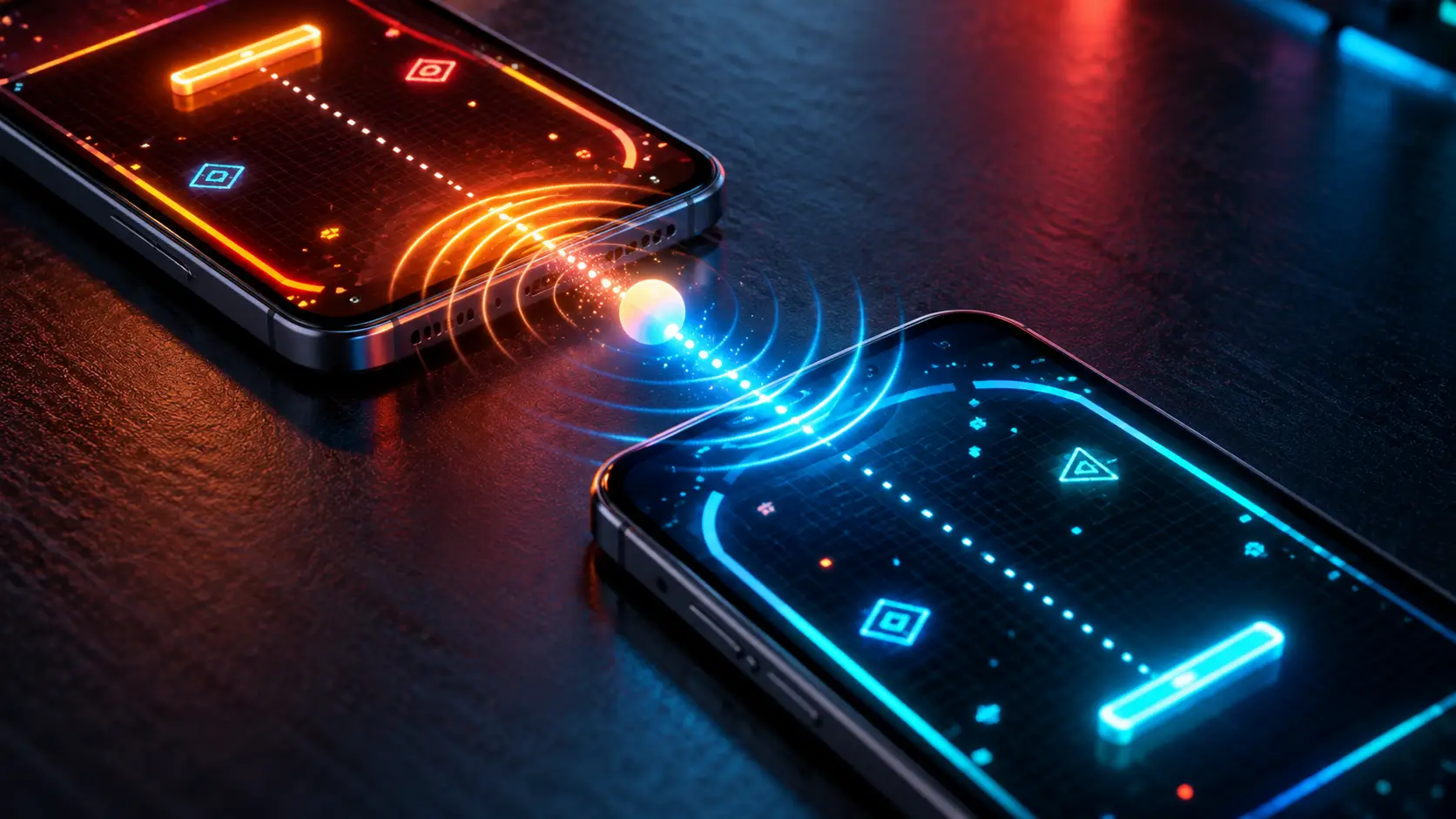
On October 15, 2026, developer Simon Willison published an unusual AI experiment. His new game, Chirp Pong, pits two smartphones against each other without using Wi-Fi or Bluetooth to communicate. Instead, the phones send the ball back and forth using sound. Willison built the game with Claude Opus 5.5 Extra in Claude Code.
The experiment shows how AI can turn an unconventional technical idea into a working browser game. Willison has made Chirp Pong available for free, so anyone can try it.
Two smartphones communicate with beeps
Chirp Pong is inspired by the classic video game Pong, but puts a distinctive spin on the format. Each player uses their own smartphone and sees just one half of the playing field.
Players place their phones a few centimetres apart, with the top edges facing each other. When a player hits the ball toward the top of their screen, it disappears. A brief electronic beep follows, and the ball appears on the opponent’s screen.
The phones exchange information through their speakers and microphones.
The system converts game data into different audio tones. The other phone’s microphone picks them up, and its software translates the signals into the ball’s position and movement.
In the public GitHub source code, Willison uses a technique called frequency-shift keying (FSK). It encodes digital information by switching between different pitches.
Each phone uses its own set of frequencies. The system also checks whether messages arrive correctly and can resend them if reception fails.
That means no central game server is needed to relay data between the phones.
More than a retro game of Pong
Willison didn’t want to simply recreate an existing Pong game. He asked Claude to add extra gameplay elements to make playing across two separate screens more interesting.
Chirp Pong therefore features a range of attacks and special effects.
Players can put spin on the ball by swiping their finger sideways. A quick upward swipe delivers a more powerful hit.
The game also features special gems that let players catch their opponents off guard. Some effects make the ball temporarily invisible, reverse the controls or spawn several balls—only one of which is real.
Another effect opens a kind of black hole that alters the ball’s trajectory.
Players can also send bombs to the other screen. If a bomb hits the opponent’s paddle, it briefly disables it.
The game rewards long rallies, too. After six successful hits, a point is worth twice as much. After twelve, it can be worth triple.
Players can choose matches to 7, 11 or 15 points. If you don’t have a second phone or an opponent, you can practise against a computer-controlled player.
Claude Code built the experiment from a short prompt
The AI angle here is less about the game itself than how it was made.
In his original blog post, Willison says he wanted to find out whether two smartphones could play a game together using sound.
He asked Claude to build a competitive, Pong-style game for two phones. The devices had to sit close together and exchange game data through sounds that a browser’s microphone API could recognise.
He also specifically requested graphical flourishes and playful additions to make the result more fun than ordinary Pong.
Willison used Claude Opus 5.5 Extra in Claude Code, Anthropic’s coding environment.
His website also features a development log with the original prompt, source code and a link to the Claude Code session.
The result is a single HTML file with JavaScript, containing the game rules, animations and the protocol the phones use to communicate.
It’s an example of vibe coding: building software by telling an AI system in plain language what to make. The user describes the idea, reviews the result and can then ask for improvements.
If you want to experiment with projects like this, AI Wereld has a detailed guide to Claude Code.
Try Chirp Pong and see what it can do
Anyone can open Chirp Pong directly in a mobile browser. There’s no need to install an app or create an account.
Open the Chirp Pong website on two phones. Select the two-player mode on both devices, turn the volume up and allow the browser to access the microphone.
Then place the phones with their top edges facing each other. One player starts the connection by tapping Call. The other phone tries to answer automatically.
The game doesn’t use Wi-Fi or Bluetooth to exchange gameplay data. Users will generally need an internet connection to open the website for the first time, however.
Microphone access is also essential. The Mozilla documentation explains that browsers require both a secure context and user permission to access the microphone.
Sound transmission is also vulnerable to real-world conditions. Background noise, low volume or phone limitations can disrupt communication. Willison describes the project as an experiment, not a thoroughly tested commercial game.
Even so, the result shows what AI-assisted software development can make possible.
Willison paired a familiar game concept with an unusual way to communicate. Claude Code helped him bring the game mechanics, user interface and audio transmission together in a single browser app.
The real story isn’t that AI can program Pong. It’s that one developer, with a relatively short prompt, can build a playable experiment in which two phones literally listen to each other.

Popular news

EU Leaders Meet in Dublin to Decide Who Pays for Europe’s AI Computing Power

Google DeepMind’s AlphaGenome 2 predicts what DNA variants do in specific cells

Anthropic Bankers Push IPO Pricing Above Initial Range to Reach 1.5 Trillion Valuation
Anthropic Says Automated Coding Tools Are Dismantling Nvidia Software Moat

US Data Brokers Supply Half Billion Dollars In AI Training Environments To Chinese Labs