DeepSeek V4-Flash Is 105x Cheaper Than Claude in a Real-World Test
NewsWednesday, 05 August 2026 at 18:00
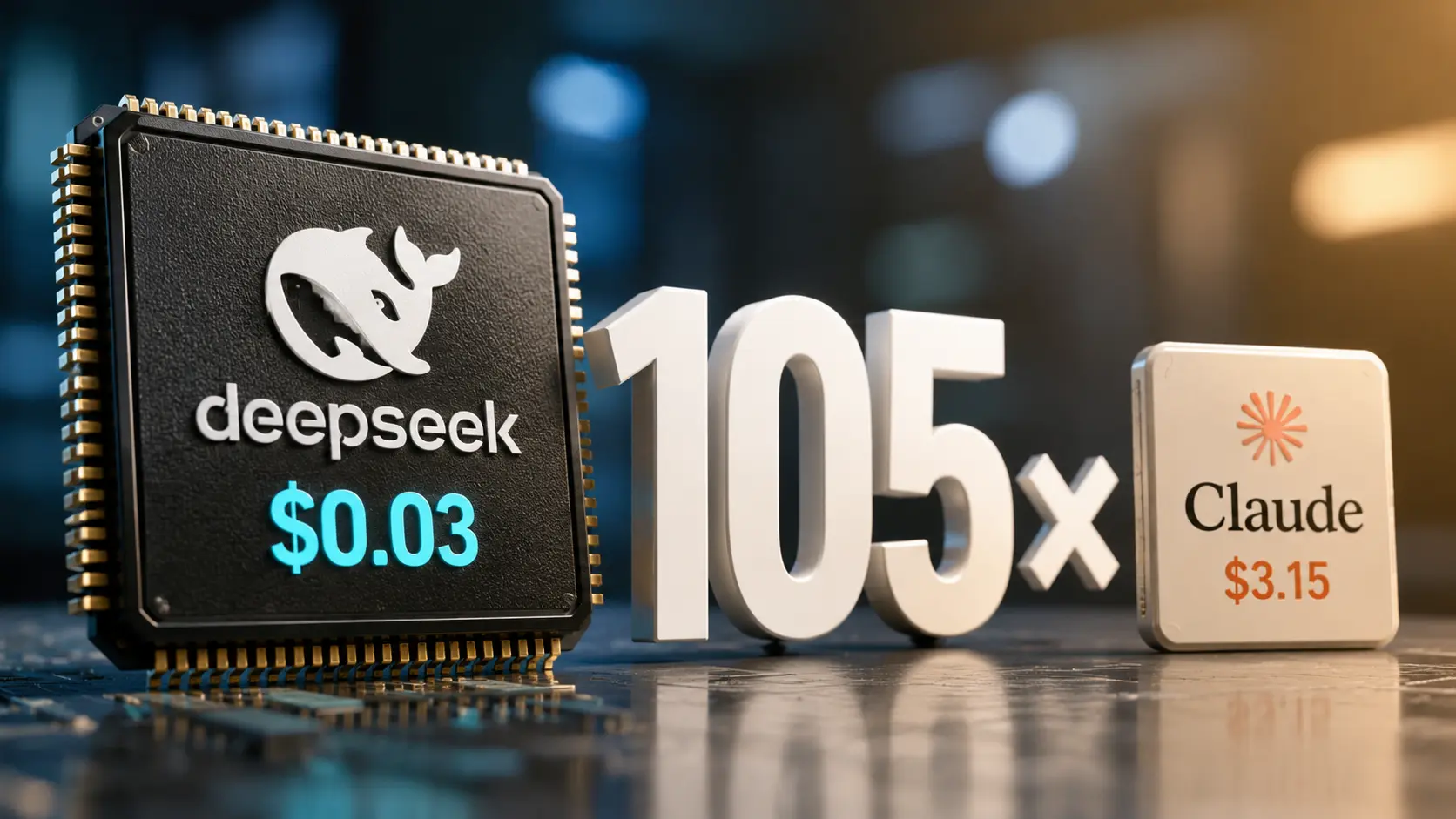
DeepSeek has set another price record in the AI market. According to new research from analytics firm Artificial Analysis, DeepSeek V4-Flash costs on average just 3 cents to complete a full benchmark test. For comparison: Anthropic Claude Fable 5 comes in at $3.15 for the same test, making the Chinese model roughly 105 times cheaper. Reuters reported the results on Monday.
The comparison doesn’t look at consumer subscriptions, but at the actual API costs incurred when different AI models run the exact same benchmark prompts. That gives a more realistic picture of what organizations actually pay in production.
Benchmark costs vary dramatically by model
Artificial Analysis calculates not only price per million tokens, but also the average cost of a complete benchmark. That avoids a skewed view, since some models use significantly more tokens or require extra steps before completing a task.
| Model | Average cost per benchmark test |
| DeepSeek V4-Flash | $0,03 |
| Kimi K3 | $0,86 |
| OpenAI GPT-5.6 Sol | $1,86 |
| Anthropic Claude Fable 5 | $3,15 |
This method shows how wide the real-world price gap can be. A model with low token rates isn’t automatically cheap if it needs far more tokens to finish the same task.
Official API pricing ranks among the market’s lowest
The benchmark aligns with the official API prices DeepSeek announced in late July for DeepSeek-V4-Flash-0731. The company charges $0.14 per million input tokens and $0.28 per million output tokens, positioning DeepSeek well below most U.S. competitors.
For companies processing millions of AI requests daily, these price gaps can add up to hundreds of thousands—or even millions—of dollars in annual savings.
Cheaper doesn’t automatically mean smarter
The low price doesn’t make V4-Flash the most capable model. On Artificial Analysis’s Intelligence Index, DeepSeek V4-Flash scores 50 points—roughly on par with Google Gemini 3.6 Flash, but trailing the latest OpenAI and Anthropic models on complex reasoning and coding tasks.
For many uses, that’s not a deal-breaker. Organizations increasingly rely on AI for high volumes of relatively simple tasks, such as:
- customer support;
- document classification;
- summarization;
- data structuring;
- first-draft copy;
- basic coding assistance.
For this kind of work, cost per usable result often matters more than the top benchmark score.
A new wave of pricing pressure in AI
The numbers underscore how fast Chinese AI firms are competing on price. While U.S. providers emphasize the most powerful frontier models, companies like DeepSeek are doubling down on affordable AI for large-scale deployment.
Reuters notes this pricing strategy is part of a broader battle among Chinese developers such as DeepSeek, Moonshot AI, Alibaba, MiniMax, and ByteDance, who have been rapidly rolling out new models and lower API rates in recent months.
For software vendors, SaaS platforms, and AI agent builders, that could be a major shift. AI operating costs are a large share of total infrastructure spend.
Open-weights model expands enterprise options
Beyond price, DeepSeek stands out because V4-Flash is available as an open-weights model. Developers can use it via the official API, self-host it on their own infrastructure, or fine-tune it for specific applications.
That gives organizations more control over costs, privacy, and data handling than fully closed AI systems. The trade-off: companies remain responsible for security, compliance, and infrastructure management.
Cost is becoming a decisive competitive edge
The Artificial Analysis benchmark shows the AI market is no longer just about peak performance. As AI scales, the focus is shifting toward cost per completed task.
On price, DeepSeek V4-Flash wins this comparison by a wide margin. For organizations handling millions of AI calls a day, that can matter more than a slightly higher benchmark score. At the same time, models from OpenAI and Anthropic remain compelling when maximum accuracy, complex reasoning, or advanced agent capabilities outweigh the lowest cost.

Latest comments
Loading