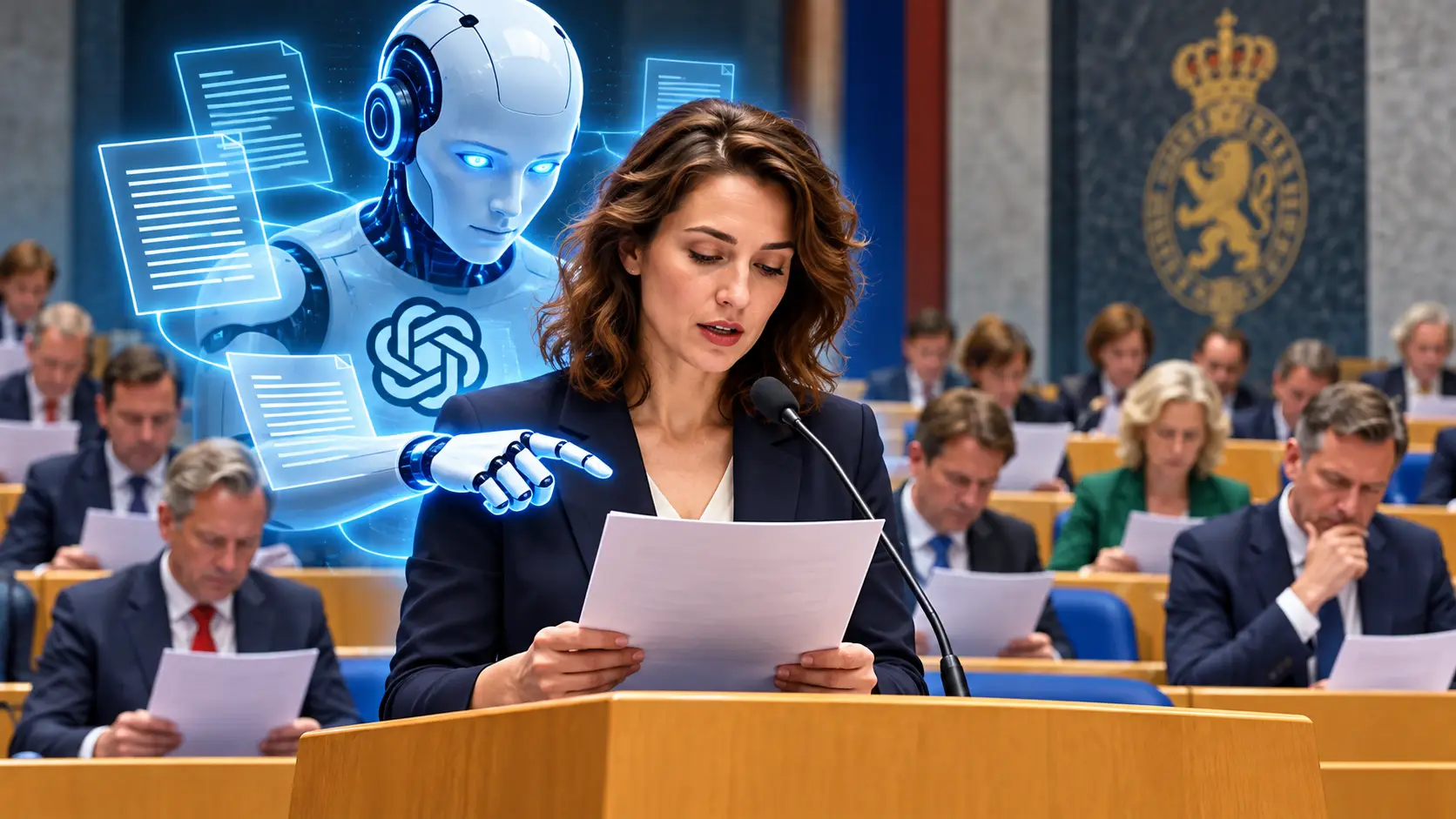
Nearly half of the Dutch House of Representatives’ members delivered speeches this year that AI-detection software identified as largely written with artificial intelligence. The analysis covered 68 MPs and nearly 300 contributions. Those are the findings of an investigation by Investico and De Groene Amsterdammer, published on Wednesday, October 21, 2026.
Politicians use chatbots such as ChatGPT and Claude to prepare their speeches. The practice spans nearly all major political parties. Some MPs use AI to shorten or polish their texts; others rely on it to rewrite entire passages.
The researchers found that at least one contribution identified by the software as largely AI-written appeared in nearly 62 percent of the parliamentary debates they examined.
AI helps write hundreds of speeches in the Dutch parliament
Investico and De Groene Amsterdammer analyzed 2,715 prepared speeches from 303 debates held between January 1 and September 30, 2026.
Of those, 297 contributions were flagged as largely written by AI. At least one such text appeared in 187 of the 303 debates.
The journalists focused on prepared remarks MPs use to open their speaking time. Spontaneous interruptions, motions and other parts of the debates were excluded.
For their analysis, they used Pangram, software designed to identify text generated by AI models. Only contributions that Pangram assessed with high confidence as more than half AI-written were included.
That means the actual use of AI could be higher. MPs who use it only for minor edits may not appear in the results.
From the PVV to D66, nearly every party uses AI
Former Pro MP Esmah Lahlah, now an alderwoman in Amsterdam, topped the list. According to the investigation, she used AI for four of the five debate contributions examined.
Next came Rachel van Meetelen of the PVV, Fatimazhra Belhirch of D66 and Wendy van Eijk of the VVD.
Less well-known and relatively new MPs appear particularly likely to use AI. Some politicians also seem to have used a chatbot to write their very first speech in the House.
The analysis found that the BBB uses AI most often at the parliamentary-group level. Around 30 percent of the party’s contributions included largely AI-written text.
Group leader Henk Vermeer sees nothing unusual in using digital tools. He compares chatbots with everyday technology such as calculators and mobile phones.
The researchers found no contributions meeting their criteria for AI-generated text from the SP, Party for the Animals or Volt.
The MPs named in the investigation responded in different ways. Some see AI as a practical tool that saves time. Others worry about becoming too dependent on the technology.
Researchers spot the writing patterns of ChatGPT and Claude
The investigation also shows how AI is changing politicians’ language.
Pangram analyzes word choice, sentence structure and rhythm, among other features. The journalists also examined which rhetorical devices appeared more often in contributions flagged as AI-generated.
One pattern stood out: the so-called rule of three, in which three arguments or examples are listed in a row.
Texts flagged as AI-written contained an average of 2.92 such three-part lists. Other contributions averaged 1.04—nearly three times fewer.
Contrasts and words such as “therefore,” “precisely” and “at the same time” also appeared more often in texts the software identified as AI-written.
Suzan Verberne, a professor of natural language processing at Leiden University, told the researchers that these stylistic differences suggest AI is doing more than correcting typos or shortening sentences. Larger sections of the text must have been rewritten, she said.
Still, an AI detector cannot prove how many of a speech’s ideas came from a chatbot. The software spots patterns in language, but cannot tell which arguments an MP came up with independently.
Detection tools can also make mistakes. To check for false positives, Investico tested 150 older debate speeches from 2019 and 2021. Pangram classified every one as human-written.
AI in politics raises questions about accountability
The investigation comes shortly after NOS found that roughly a quarter of written parliamentary questions had been drafted partly with AI.
Prime Minister Rob Jetten also uses AI to write social media posts.
The latest figures show that chatbots now play a clear role in parliamentary debates themselves.
There are potential benefits. MPs with limited support can use AI to summarize complex information, organize arguments or make a lengthy speech easier to understand.
But new risks come with those benefits. Chatbots can make mistakes, produce persuasive-sounding but inaccurate information and reinforce existing political views.
And when politicians rely on the same AI models, they may start using the same phrases and argument structures.
Tom Dobber, an assistant professor of political communication at the University of Amsterdam, says outsourcing parliamentary speeches touches on a core democratic principle: elected representatives should be able to express their own beliefs.
The investigation raises a broader question: as AI plays a growing role in political speeches, how can voters tell which words and arguments truly come from their representatives?
Ultimately, responsibility for the content rests with the politician who delivers the words in the House.

Popular news
EU Leaders Meet in Dublin to Decide Who Pays for Europe’s AI Computing Power
Google DeepMind’s AlphaGenome 2 predicts what DNA variants do in specific cells
Anthropic Bankers Push IPO Pricing Above Initial Range to Reach 1.5 Trillion Valuation
Anthropic Says Automated Coding Tools Are Dismantling Nvidia Software Moat

US Data Brokers Supply Half Billion Dollars In AI Training Environments To Chinese Labs