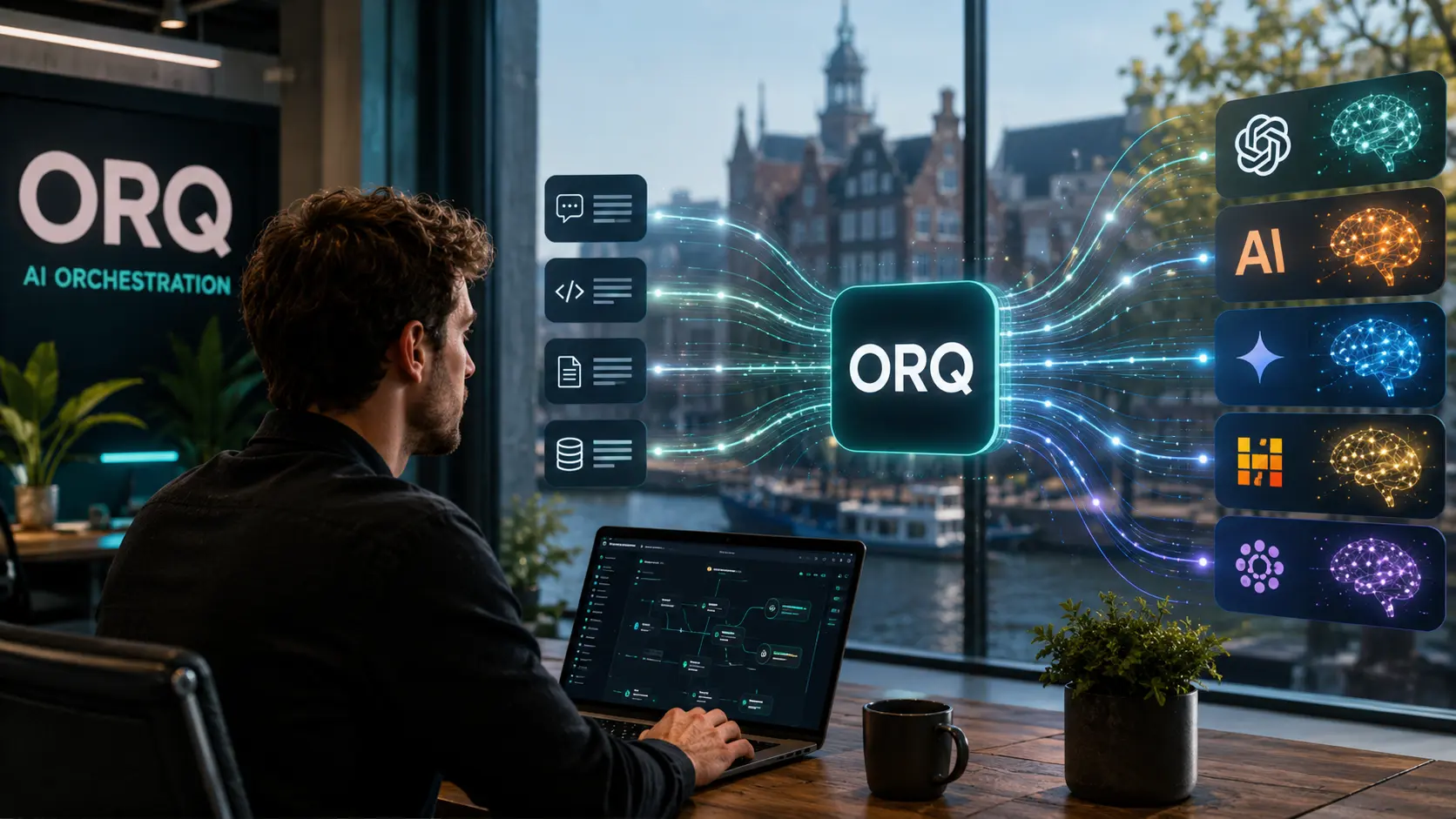
Generative AI is evolving at breakneck speed. More and more organizations are building applications with language models from OpenAI, Anthropic, Google and Meta. At the same time, complexity is rising. Companies often juggle multiple models, dozens of prompts, different datasets and disparate development teams. Without central control, you quickly end up with a tangle of loose scripts, experiments and API hookups.
ORQ.ai wants to fix that. The Dutch company offers a platform that lets organizations manage the full lifecycle of generative AI applications. From prompt development and model selection to monitoring, evaluation, governance and cost control—everything runs from one central environment.
Where developers once needed separate tools to build and manage AI solutions, ORQ.ai brings those capabilities together in a single platform. The company targets organizations that don’t just want to experiment with AI, but want to deploy it safely, at scale, and under control in production.
What is ORQ.ai?
ORQ.ai is an AI Collaboration Platform built for companies working with Large Language Models (LLMs). The platform acts as a central layer between AI applications and multiple model providers.
That means developers no longer have to build separate integrations for OpenAI, Anthropic, Google Gemini or other vendors. All AI requests flow through one unified infrastructure where routing, security, monitoring and version control are centrally managed.
The approach mirrors how API Gateways have long been used in traditional software development. ORQ.ai applies the same principle to generative AI.
The result: a single control point for all AI traffic across the organization.
Why does ORQ.ai exist?
Many organizations start small with generative AI. One developer builds a chatbot with GPT-4, another department experiments with Claude, and a data scientist tests Gemini or an open-source model.
At first, that seems efficient. Over time, new challenges emerge.
An organization needs to know, for example:
- which model delivers the best results;
- how much each AI call costs;
- which prompts are running in production;
- which team member made changes;
- how model performance shifts after updates;
- whether sensitive data is processed securely.
These questions are hard to answer when every application has its own AI integration.
ORQ.ai centralizes these processes so organizations keep a grip on their entire AI landscape.
From experiment to production
The key difference between a proof of concept and an enterprise AI solution is operations.
Spinning up a simple chatbot now takes just a few hours. Building a reliable AI solution that serves thousands of users is far more complex.
Organizations must account for:
- performance;
- availability;
- error handling;
- compliance;
- security;
- logging;
- monitoring;
- costs.
That’s exactly where ORQ.ai positions itself.
The platform helps organizations bring AI solutions into production in a controlled way without developers having to build all the infrastructure themselves.
One platform for the full AI lifecycle
While many AI tools focus on one slice of the development process, ORQ.ai aims to support the entire generative AI lifecycle.
It starts with prompt design.
Teams can then test different language models, compare performance, run evaluations and pick the best configuration.
After deployment, the platform keeps monitoring the application. Developers get insights into latency, error rates, token usage, costs and user feedback.
This creates a continuous improvement loop in which AI applications can be progressively optimized.
AI Gateway as the central hub
One of ORQ.ai’s core components is the AI Gateway.
This gateway is the intermediary layer between an application and the various AI models.
Instead of connecting directly to OpenAI or Anthropic, an application talks only to the gateway.
That brings multiple advantages.
Centralized model routing
When a user asks an AI application a question, the gateway decides which model to use.
That choice can be based on various factors, such as:
| Factor | Example |
| Cost | Use a cheaper model for simple queries |
| Speed | Pick the model with the lowest latency |
| Quality | Use the most capable model for complex tasks |
| Availability | Automatically fail over during outages |
Developers don’t need to change their software every time they want to switch models.
Automatic fallbacks
No language model has 100 percent uptime.
Outages happen, and providers can experience temporary latency spikes.
ORQ.ai can automatically switch to an alternative model when a provider is unavailable.
Applications keep running without human intervention.
For companies using AI in customer service or internal processes, that’s critical.
Reduce vendor lock-in
Many organizations fear vendor lock-in.
When software depends entirely on one AI provider, switching becomes painful.
ORQ.ai aims to reduce that risk.
Because multiple providers are orchestrated through the same infrastructure, organizations can switch between models more easily.
That brings flexibility when prices change or new models outperform the old.
Enterprise-grade prompt management
Prompts are now a critical component of modern AI applications.
Many organizations already have hundreds of prompts.
If every developer manages them locally, chaos follows.
ORQ.ai treats prompts like software code.
Every change is stored.
Teams can roll back to previous versions.
Developers can see exactly what changed and who changed it.
Collaboration becomes much easier.
Evaluations that make AI more reliable
A language model can perform brilliantly today and degrade tomorrow.
New model versions regularly change AI behavior.
That’s why ORQ.ai introduces comprehensive evaluations, or evals.
These let organizations systematically test how well a model performs.
For example:
- is the answer factually correct;
- is the tone consistent;
- how much does the model hallucinate;
- how many tokens are used;
- how fast is the response;
- what are the total costs?
Comparing models side by side yields a more objective view of performance.
It prevents organizations from choosing a model based on gut feel alone.
Real-time monitoring
An AI application doesn’t stop evolving once it’s live.
That’s when the real work begins.
ORQ.ai continuously monitors how applications perform.
Dashboards show, among other things:
- response times;
- error rates;
- token usage;
- model usage;
- costs per project;
- quality scores;
- user feedback.
This information helps developers spot issues quickly.
If a new model suddenly slows down or produces more errors, it’s immediately visible.
Why observability matters more and more
Observability is becoming a core concept in AI development.
Where traditional software mainly produces logs, AI systems generate far more data.
Every prompt, model choice, context, tool call and generated output adds new signals.
By recording this data centrally, you get insight into an AI application’s end-to-end behavior.
That makes debugging easier and helps organizations continuously improve AI systems.
Workflow Editor and AI Agents
A key part of ORQ.ai is the visual workflow editor. It lets teams build AI applications without hard-coding every step. Developers combine prompts, knowledge sources, external tools and multiple language models into one clear workflow.
Every step in the workflow is visible. Developers see exactly which prompt is used, which model generates an answer, how many tokens are consumed and how long each step takes. That makes it easier to debug and optimize performance.
The editor also supports AI agents—AI systems that can autonomously execute multiple actions to complete a task. An agent can, for example, locate documents, summarize information, call an external API and then formulate a full answer.
Managing agents centrally provides more control over complex, multi-step AI workflows.
Retrieval-Augmented Generation (RAG)
Many organizations want AI to answer based on internal documents instead of general knowledge alone. Retrieval-Augmented Generation (RAG) is commonly used for this.
Within ORQ.ai, teams can create knowledge bases that store documents like PDFs, Word files, spreadsheets and text files. The platform indexes this content so a language model can reference relevant documents during a conversation.
That enables an AI assistant to answer using internal manuals, contracts, product docs or policy papers.
This approach reduces hallucinations and aligns answers with an organization’s most current information.
Integrations with multiple AI models
The language model market is moving fast. Where companies mostly used OpenAI a few years ago, organizations now increasingly run with multiple providers.
ORQ.ai supports this shift by exposing hundreds of models through one unified API.
Among the supported providers:
- OpenAI
- Anthropic
- Google Gemini
- Azure OpenAI
- Meta Llama
- Mistral AI
- Cohere
- xAI
- Open-source models via your own infrastructure
This creates a flexible architecture where organizations can choose the best model per use case.
A simple classification task doesn’t need an expensive model. Complex analyses can be routed to a more powerful one.
Bringing builders and business together
AI projects are no longer just for software engineers. Product managers, content specialists, data experts and compliance teams all play a role.
ORQ.ai simplifies collaboration by bringing everyone into one environment.
Prompts can be co-developed, evaluations are visible across teams and changes are tracked automatically.
This reduces dependency on individual developers and improves knowledge sharing across the organization.
Governance and compliance
As AI’s role grows, so does the focus on regulation. European companies increasingly need to show how AI systems function, what data is processed and who is responsible for changes.
ORQ.ai addresses this with robust governance features.
Administrators can centrally define:
- which users have access;
- which models are approved;
- which projects are active;
- which prompts are in production;
- which API keys are available.
Changes are also captured automatically via audit logs. This makes it possible to see who modified a prompt or when a new model configuration was rolled out.
For larger organizations, this is a vital pillar of internal compliance processes.
Security
Beyond governance, security is taking center stage in generative AI.
Companies often process sensitive customer data, internal documents or trade secrets. The AI isn’t the only thing that must be trustworthy—the surrounding infrastructure must be too.
ORQ.ai supports, among other things:
- role-based access control;
- Single Sign-On (SSO);
- audit logs;
- encrypted communication;
- API key management;
- data segmentation;
- support for European regulations.
The platform is also SOC 2 certified and supports deployments across different cloud environments, including Virtual Private Cloud (VPC) and on-premises setups for organizations with stricter security demands.
SDKs, CLI and developer tools
For software developers, ORQ.ai offers tools to build AI applications faster.
Official SDKs are available for Python and Node.js, making it easy to connect to the AI Gateway and use the platform’s full capabilities.
There’s also a Command Line Interface (CLI).
With this terminal tool, developers can:
- perform deployments;
- manage prompts;
- launch agents;
- test API calls;
- automate configurations.
ORQ.ai fits neatly into existing DevOps practices and CI/CD pipelines.
Pricing
ORQ.ai offers several subscription tiers.
The free Developer plan is designed for experiments and proofs of concept, letting developers explore the platform without upfront costs.
For production, the Growth plan adds richer features, higher limits and support for larger teams.
Large organizations can opt for an Enterprise license, which includes advanced security options, Single Sign-On, dedicated support and additional compliance features.
Final pricing depends on the number of users, AI usage and any add-on modules such as Knowledge Bases.
Real-world use cases
A growing number of organizations rely on ORQ.ai to bring generative AI into production in a controlled way.
Pension provider Brand New Day, for instance, significantly reduced AI agent development time by handling evaluations, monitoring and deployments from one platform.
Energy company Zonneplan uses the platform to automate a large share of customer inquiries. By continuously comparing multiple language models, the company optimizes both quality and operating costs.
ORQ.ai is also used in healthcare, content production and professional services. Despite the varied sectors, the goal is the same: deploy AI reliably, manageably and at scale.
How does ORQ.ai compare to rivals?
The LLMOps market is growing fast. ORQ.ai competes with specialized platforms like LangSmith, Langfuse, Humanloop, Portkey, Helicone and Weights & Biases.
The main difference is positioning.
LangSmith focuses on evaluations and debugging within the LangChain ecosystem.
Langfuse emphasizes observability and monitoring.
Portkey primarily positions itself as an AI Gateway.
ORQ.ai tries to combine all these components into one integrated platform. That reduces the need to stitch together separate tools and creates a single workspace for the entire AI lifecycle.
Strengths of ORQ.ai
The platform’s key strengths include:
- Central AI Gateway for multiple model providers.
- Extensive monitoring and observability.
- Advanced prompt management.
- Built-in evaluations.
- Support for AI agents.
- Governance and compliance features.
- Integration with hundreds of language models.
- Reduced dependence on a single AI vendor.
Potential caveats
ORQ.ai is primarily designed for organizations deploying AI at scale. For individual developers or small projects, the platform may be more than needed.
A central AI infrastructure also requires careful implementation. Teams must integrate existing AI applications into the gateway, which can require additional configuration depending on the environment.
Conclusion
ORQ.ai positions itself as much more than a simple AI Gateway. It’s a complete environment for building, testing, monitoring and managing generative AI applications across the enterprise.
By uniting AI routing, prompt management, evaluations, observability, governance and collaboration, it helps companies keep control over an increasingly complex AI landscape. Organizations that use multiple language models and treat AI as a strategic technology will benefit most from this centralized approach.
With growing scrutiny around compliance, cost control and reliability, ORQ.ai taps into a broader market shift: generative AI is moving from isolated experiments to business-critical deployments. In that phase, a platform combining control, insight and scalability becomes essential.

Latest comments
Loading